WATER
Please be conservation minded when watering.
Late evening, night time, or early morning watering is a better time to prevent evaporation.
Please be sure your home has no small leaks in faucets or toilets. These can waste much more than you may think, sometimes even thousands of gallons from one leak in just a month.
2025 Annual Water Quality Report
Town of Midwest
PWS WY5600201
Spanish (Espanol)
Este informe contiene informacion muy importante sobre la calidad de su agua beber. Traduscalo o hable con alguien que lo entienda bien.
Is my water safe?
We are pleased to present this year's Annual Water Quality Report (Consumer Confidence Report) as required by the Safe Drinking Water Act (SDWA). This report is designed to provide details about where your water comes from, what it contains, and how it compares to standards set by regulatory agencies. This report is a snapshot of last year's water quality. We are committed to providing you with information because informed customers are our best allies.
Do I need to take special precautions?
Some people may be more vulnerable to contaminants in drinking water than the general population. Immuno-compromised persons such as persons with cancer undergoing chemotherapy, persons who have undergone organ transplants, people with HIV/AIDS or other immune system disorders, some elderly, and infants can be particularly at risk from infections. These people should seek advice about drinking water from their health care providers. EPA/Centers for Disease Control (CDC) guidelines on appropriate means to lessen the risk of infection by Cryptosporidium and other microbial contaminants are available from the Safe Water Drinking Hotline (800-426-4791).
Where does my water come from?
Our water comes from the North Platte River and is purchased through Central Wyoming Regional Water System.
Source water assessment and its availability
Consumers may contact Central Regional Water System for additional information and the Source Water Assessment.
Why are there contaminants in my drinking water?
Drinking water, including bottled water, may reasonably be expected to contain at least small amounts of some contaminants. The presence of contaminants does not necessarily indicate that water poses a health risk. More information about contaminants and potential health effects can be obtained by calling the Environmental Protection Agency's (EPA) Safe Drinking Water Hotline (800-426-4791). The sources of drinking water (both tap water and bottled water) include rivers, lakes, streams, ponds, reservoirs, springs, and wells. As water travels over the surface of the land or through the ground, it dissolves naturally occurring minerals and, in some cases, radioactive material, and can pick up substances resulting from the presence of animals or from human activity: microbial contaminants, such as viruses and bacteria, that may come from sewage treatment plants, septic systems, agricultural livestock operations, and wildlife; inorganic contaminants, such as salts and metals, which can be naturally occurring or result from urban stormwater runoff, industrial, or domestic wastewater discharges, oil and gas production, mining, or farming; pesticides and herbicides, which may come from a variety of sources such as agriculture, urban stormwater runoff, and residential uses; organic Chemical Contaminants, including synthetic and volatile organic chemicals, which are by-products of industrial processes and petroleum production, and can also come from gas stations, urban stormwater runoff, and septic systems; and radioactive contaminants, which can be naturally occurring or be the result of oil and gas production and mining activities. In order to ensure that tap water is safe to drink, EPA prescribes regulations that limit the amount of certain contaminants in water provided by public water systems. Food and Drug Administration (FDA) regulations establish limits for contaminants in bottled water which must provide the same protection for public health.
How can I get involved?
We hold meetings at the Town Counsel building on the 2nd and 4th Wednesday of each month at 5:30 P.M.
Water Conservation Tips
Did you know that the average U.S. household uses approximately 400 gallons of water per day or 100 gallons per person per day? Luckily, there are many low-cost and no-cost ways to conserve water. Small changes can make a big difference - try one today and soon it will become second nature.
-
Take short showers - a 5 minute shower uses 4 to 5 gallons of water compared to up to 50 gallons for a bath.
-
Shut off water while brushing your teeth, washing your hair and shaving and save up to 500 gallons a month.
-
Use a water-efficient showerhead. They're inexpensive, easy to install, and can save you up to 750 gallons a month.
-
Run your clothes washer and dishwasher only when they are full. You can save up to 1,000 gallons a month.
-
Water plants only when necessary.
-
Fix leaky toilets and faucets. Faucet washers are inexpensive and take only a few minutes to replace. To check your toilet for a leak, place a few drops of food coloring in the tank and wait. If it seeps into the toilet bowl without flushing, you have a leak. Fixing it or replacing it with a new, more efficient model can save up to 1,000 gallons a month.
-
Adjust sprinklers so only your lawn is watered. Apply water only as fast as the soil can absorb it and during the cooler parts of the day to reduce evaporation.
-
Teach your kids about water conservation to ensure a future generation that uses water wisely. Make it a family effort to reduce next month's water bill!
-
Visit www.epa.gov/watersense for more information.
Cross Connection Control Survey
The purpose of this survey is to determine whether a cross-connection may exist at your home or business. A cross connection is an unprotected or improper connection to a public water distribution system that may cause contamination or pollution to enter the system. We are responsible for enforcing cross-connection control regulations and insuring that no contaminants can, under any flow conditions, enter the distribution system. If you have any of the devices listed below please contact us so that we can discuss the issue, and if needed, survey your connection and assist you in isolating it if that is necessary.
-
Boiler/ Radiant heater (water heaters not included)
-
Underground lawn sprinkler system
-
Pool or hot tub (whirlpool tubs not included)
-
Additional source(s) of water on the property
-
Decorative pond
-
Watering trough
Source Water Protection Tips
Protection of drinking water is everyone's responsibility. You can help protect your community's drinking water source in several ways:
-
Eliminate excess use of lawn and garden fertilizers and pesticides - they contain hazardous chemicals that can reach your drinking water source.
-
Pick up after your pets.
-
If you have your own septic system, properly maintain your system to reduce leaching to water sources or consider connecting to a public water system.
-
Dispose of chemicals properly; take used motor oil to a recycling center.
-
Volunteer in your community. Find a watershed or wellhead protection organization in your community and volunteer to help. If there are no active groups, consider starting one. Use EPA's Adopt Your Watershed to locate groups in your community, or visit the Watershed Information Network's How to Start a Watershed Team.
-
Organize a storm drain stenciling project with your local government or water supplier. Stencil a message next to the street drain reminding people "Dump No Waste - Drains to River" or "Protect Your Water." Produce and distribute a flyer for households to remind residents that storm drains dump directly into your local water body.
Additional Information for Lead
The system inventory does not include lead service lines.
We used a combination of past and present operator knowledge as well as contractor knowledge.
Consumers can access the Lead Service Line Survey results by contacting the Midwest
Town Hall at (307) 467-6513, or by visiting in person at 531 Peake Street, Midwest WY 82643
Lead can cause serious health effects in people of all ages, especially pregnant women, infants, and young children. Lead in drinking water is primarily from materials and components associated with service lines and home plumbing. MIDWEST, TOWN OF is responsible for providing high quality drinking water and removing lead pipes but cannot control the variety of materials used in plumbing components in your home. Because lead levels may vary over time, lead exposure is possible even when your tap sampling results do not detect lead at one point in time. You share the responsibility for protecting yourself and your family from the lead in your home plumbing. You can take responsibility by identifying and removing lead materials within your home plumbing and taking steps to reduce your family's risk. Before drinking tap water, flush your pipes for several minutes by running your tap, taking a shower, doing laundry or a load of dishes. Use only cold water for drinking, cooking, and making baby formula. Boiling water does not remove lead from water. If you have a lead service line or galvanized requiring replacement service line, you may need to flush your pipes for a longer period. You can also use a filter certified by an American National Standards Institute accredited certifier to reduce lead in drinking water. If you are concerned about lead in your water and wish to have your water tested, contact MIDWEST, TOWN OF (Public Watersystem Id: WY5600201) by calling 307-437-6513 or emailing midpw@rtconnect.net. Information on lead in drinking water, testing methods, and steps you can take to minimize exposure is available at http://www.epa.gov/safewater/lead.
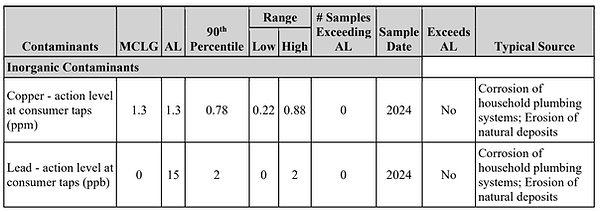
Water Quality Data Table
In order to ensure that tap water is safe to drink, EPA prescribes regulations which limit the amount of contaminants in water provided by public water systems. The table below lists all of the drinking water contaminants that we detected during the calendar year of this report. Although many more contaminants were tested, only those substances listed below were found in your water. All sources of drinking water contain some naturally occurring contaminants. At low levels, these substances are generally not harmful in our drinking water. Removing all contaminants would be extremely expensive, and in most cases, would not provide increased protection of public health. A few naturally occurring minerals may actually improve the taste of drinking water and have nutritional value at low levels. Unless otherwise noted, the data presented in this table is from testing done in the calendar year of the report. The EPA or the State requires us to monitor for certain contaminants less than once per year because the concentrations of these contaminants do not vary significantly from year to year, or the system is not considered vulnerable to this type of contamination. As such, some of our data, though representative, may be more than one year old. In this table you will find terms and abbreviations that might not be familiar to you. To help you better understand these terms, we have provided the definitions below the table.
ug/L: Number of micrograms of substance in one liter of water
ppm: parts per million, or milligrams per liter (mg/L)
ppb: parts per billion, or micrograms per liter (µg/L)
mg/L: Number of milligrams of substance in one liter of water
pCi/L: picocuries per liter (a measure of radioactivity)
NTU: Nephelometric Turbidity Units. Turbidity is a measure of the cloudiness of the water. We monitor it because it is a good indicator of the effectiveness of our filtration system.
NA: not applicable
ND: Not detected
NR: Monitoring not required, but recommended.
lmportant Drinking Water Definitions
MCLG: Maximum Contaminant Level Goal: The level of a contaminant in drinking water below which there is no known or expected risk to health. MCLGs allow for a margin of safety.
MCL: Maximum Contaminant Level: The highest level of a contaminant that is allowed in drinking water. MCLs are set as close to the MCLGs as feasible using the best available treatment technology.
TT: Treatment Technique: A required process intended to reduce the level of a contaminant in drinking water.
AL: Action Level: The concentration of a contaminant which, if exceeded, triggers treatment or other requirements which a water system must follow.
Variances and Exemptions
Variances and Exemptions: State or EPA permission not to meet an MCL or a treatment technique under certain conditions.
MRDLG: Maximum residual disinfection level goal. The level of a a drinking water disinfectant below which there is no known or expected risk to health. MRDLGs do not reflect the benefits of the use of disinfectants to control microbial contaminants.
MRDL: Maximum residual disinfectant level. The highest level of a disinfectant allowed in drinking water. There is convincing evidence that addition of a disinfectant is necessary for control of microbial contaminants.
MNR: Monitored Not Regulated
MPL: State Assigned Maximum Permissible Level
For more information please contact:
Contact Name: Jaime Jones
Address: PO Box 190
Midwest, WY 82643
Phone: (307) 437-6513 ext.4